BOUNDED INTERFACE FORMALISM AND CONSTRAINED INTERACTION REALISATION
Foundational Operator Architecture for Phase 6 Interaction Mechanics

Author: HybridMind42
Project Lineage: The Atlas-Rosetta Framework — Phase 6 Manuscript Assembly
Date: 26 May 2026
Series: HybridMind42 | Atlas-Rosetta Framework | Phase 6: Interaction Mechanics | Paper I
Classification: Foundational Operator Architecture / Component Registry / Epistemic Containment Core
PUBLIC PREFACE
This paper opens Phase 6 of the HybridMind42 Atlas-Rosetta Framework.
Where Phase 5 examined persistence within boundary-conditioned systems, Phase 6 examines how already-persistent systems interact, filter, couple, resist, or fail across admissible interfaces.
The paper introduces a bounded interface formalism for describing constrained interaction realisation without replacing domain-specific physical laws. Its purpose is not universal explanation, but disciplined cross-domain comparison under strict epistemic containment.
ABSTRACT
This paper introduces an operational taxonomy for analysing how boundary interfaces govern the transition between latent states and active systemic coupling. Extending the HybridMind42 Atlas-Rosetta Framework from Phase 5 Persistence mechanics into Phase 6 Interaction Mechanics, we formalise the interface as an active, variance-sensitive boundary characterised by an explicit Interface Impedance operator Z_int.
We demonstrate that constrained interaction realisation is jointly constrained by the admissibility structure of the interacting systems and their allowable mediator channels, independent of input amplitude. Grounded in the HQP primitive structure and the BFPF operator set, this paper examines how already-persistent systems enter, resist, filter, or fail under cross-boundary interaction.
By introducing a non-linear Hysteretic Memory Operator H-hat, we model path-dependent recovery dynamics, asymmetric reopening lags, and non-recovering boundary transitions commonly observed during interface overload across heterogeneous substrates. The resulting cybernetic runtime loop couples environmental forcing functions with internal state reconfigurations via a continuous realisation error minimisation gradient.
We apply this taxonomy forensically to documented failures across mechanical, computational, and socio-technical systems, demonstrating that catastrophic breakdown tracks consistently with identifiable interface regulation pathology or lossy feature erasure. Crucially, the framework functions as an organisational grammar of constraint topology rather than an ontological substrate model, maintaining strict scale separation and domain-specific parameterisation limits.
INTRODUCTION
1.1 Problem Statement and Contextual Drift
The structural analysis of open systems across disparate scientific fields faces a recurring failure mode: conceptual drift via unconstrained pattern accumulation. When cross-domain systems are compared, structural analogies frequently collapse into universalist rhetoric or speculative substance models. This framework addresses this vulnerability by moving away from ontological assertions (“what a system is”) to isolate the exact, mathematically trackable mechanisms that govern interactive state transitions at system boundaries (“how a system filters interaction”).
Many systems possess geometrically or causally available trajectories that never become active interactions. Spatial or causal connectivity alone is insufficient to guarantee systemic coupling. Signals, fluxes, and data streams continuously encounter boundary interfaces that selectively permit, suppress, attenuate, redirect, or transform potential inputs. This paper establishes an organisational grammar for categorising these realisation conditions without modifying, reinterpreting, or replacing existing domain-specific physical theories. We distinguish systematically between causal availability, boundary admissibility, interaction realisation, and regime transition.
1.2 Canonical Lineage: The HQP to BFPF Bridge
This paper explicitly extends the HybridMind42 Atlas-Rosetta Framework from Phase 5 Persistence mechanics into Phase 6 Interaction Mechanics. Phase 6 Interaction Mechanics must not appear to replace, overwrite, or redefine the foundational structures established in the Holistic Quantised Persistence (HQP) model or the Boundary-Filtered Persistence Framework (BFPF). Instead, it functions strictly as the next operational layer: a formal analysis of how already-persistent systems interact across admissible boundaries.
Phase 5 Persistence established that persistence is not generated by force alone, but permitted by admissible boundaries.
Using the HQP primitive structure:
HQP = {G, B, I, P}
where G represents Interface Geometry, B represents Boundary, I represents Injection, and P represents Persistence — and the BFPF operator set:
BFPF = {Ω, B, M, P}
where Ω represents environmental variance, B represents boundary filtering, M represents mediator-boundary coupling, and P represents stochastic realisation — this paper examines how systems that have already achieved homeostatic stability enter, resist, filter, or fail when subjected to external cross-boundary interaction.
The core thesis remains invariant: suppression is not prohibition; rather, the selective restriction of potential input paths is the definitive mechanism by which systemic persistence is maintained.
1.3 The Core Scope and Substrate Separation Barrier
To preserve absolute empirical discipline and protect the framework from interpretive inflation, this architecture adopts a fundamental boundary rule:
Axiom GR-01A (Substrate Non-Identity): Structural analogy across disparate system domains does not imply or require mechanistic identity.
Two systems may exhibit identical transition curves, comparable saturation thresholds, or related filtering behaviours while operating under entirely separate physical laws. Capillary transport, receptor binding, network packet routing, and administrative data filtering arise from distinct material mechanisms operating across radically different scales. This framework evaluates operational similarities in constraint topology, not ontological equivalence across material substrates. The framework functions as an analytical toolset for comparative constraint taxonomy, not a universal replacement language.
CORE DEFINITIONS AND STRATIFIED INTERACTION LEXICON
To prevent the semantic degradation common to interdisciplinary frameworks, terms are strictly stratified into three non-overlapping operational layers. Every new Phase 6 operator is explicitly mapped back to its ancestral HQP and BFPF roots to maintain absolute structural continuity.
2.1 Layer 1: The Primitive Register (PR)
PR-01: Boundary Interface (B)
[Descended from HQP Boundary B]
The localised topological interface zone where a system’s internal parameters or state variables switch values relative to the ambient background matrix. It is formalised as a measurable mediator layer regulating trans-boundary flux J.
PR-02: Boundary Admissibility (α)
[Directly inherits the Existing DR Admissibility Definition]
The relational compatibility metric between an incoming forcing function and the receiving interface (α ∈ [0, 1]).
The values α = 0 and α = 1 represent idealised limiting conditions; real systems frequently operate across probabilistic or continuously varying admissibility distributions.
Boundary admissibility is bounded entirely by the structural rules of the receiver, independent of input amplitude.
PR-03: Constraint (κ)
Any geometric, thermodynamic, computational, or physical rule that systematically restricts the available degrees of freedom or phase space of a system’s internal components.
PR-04: Stress Vector (σ)
[Descended from HQP Injection I]
The directional magnitude of external variance, thermodynamic loading, or signal injection applied across a localised boundary segment per unit time.
PR-05: Adaptive Capacity (A_C)
[Descended from Phase 5 Resilience / Repair Capacity]
The finite structural or computational resource buffer a system can deploy to modulate its interface parameters before experiencing irreversible material or topological deformation.
2.2 Layer 2: The State Register (SR)
SR-01: Latent State (S_lat)
A configuration where a causally valid trajectory exists between an input and the boundary B, but no operational event occurs because interface admissibility is absolute zero (α = 0).
SR-02: Coupled Interaction State (S_coup)
A configuration where the incoming forcing function satisfies the boundary criteria (α > 0), resulting in a non-zero realisation parameter (ρ > 0) that binds the trajectories of sender and receiver.
SR-03: Saturated State (S_sat)
A phase where the amplitude or frequency of the incoming forcing function has completely occupied all available interaction sites or eclipsed the throughput of the mediator layer, converting the filter into an effectively saturated bottleneck.
SR-04: Regime Shift (ΔR)
[Descended from Phase 5 Collapse / Threshold Failure]
A discontinuous, non-linear transition where a system’s internal state variables uncouple from a prior homeostatic baseline and snap to an entirely separate region of phase space due to boundary structural failure.
2.3 Layer 3: The Operator Register (OR)
OR-01: The Adsorptive Mode (A-hat_d)
Interface-localised coupling, where coupling occurs strictly at the two-dimensional surface of the boundary without migrating into the internal bulk volume.
OR-02: The Absorptive Mode (A-hat_b)
Volumetric integration, where the input penetrates the boundary interface and diffuses uniformly throughout the internal bulk mass matrix, modifying internal parameter configurations.
OR-03: Channeling (The Channeler Invariant) (C)
The topological compression of multi-directional agent trajectories into low-action, high-persistence, unidirectional corridors due to external geometric or potential constraints.
OR-04: Response Synchronisation (R_S)
The rate at which the internal state variables of coupled systems converge toward a unified trajectory after crossing an admissible boundary threshold.
OR-05: Compensatory Routing (C_R)
An internal state adjustment where a system dynamically closes a saturated or degraded boundary sector and diverts incoming flux toward alternative, non-saturated interface regions to preserve structural equilibrium.
INTERFACE REGULATION AND ATTENUATION DYNAMICS
3.1 First-Order Attenuation Modelling
The boundary interface B acts as an active, variance-sensitive topological filter. The transition of an environmental forcing function S_E into a realised internal signal S_O [Descended from BFPF Stochastic Realisation P] is regulated by the Interface Impedance Z_int. This operator is formalised as the mathematical expression of mediator-boundary coupling, functioning as an inverse first-order approximation of permeability P_int:
Z_int ∝ 1 / P_int
The first-order continuous attenuation model is formalised as:
S_O(t) = ∫[0,∞] α_v(κ) · [S_E(t − τ) · e^(−Z_int · H-hat · τ)] dτ
Where α_v(κ) represents the structural constraint filter acting on incoming variance patterns, and H-hat is the active hysteretic path operator.
Attenuation functions as a signal-shaping operator, selectively altering the topology of incoming variance to preserve internal equilibrium.
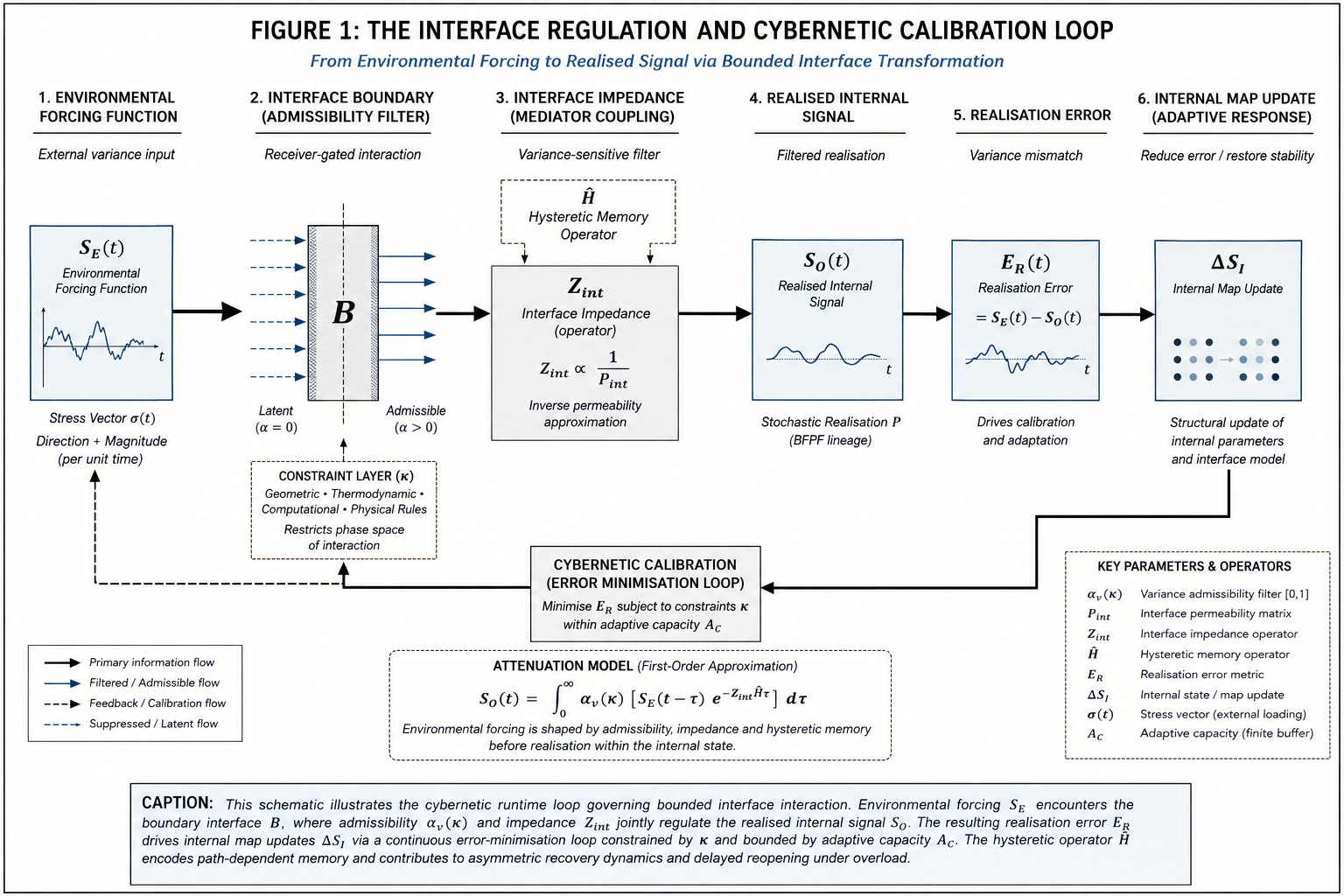
Figure 1. The Interface Regulation and Cybernetic Calibration Loop
Schematic block diagram illustrating the transformation of environmental forcing functions S_E through interface impedance Z_int into realised internal signals S_O. The schematic maps the feedback pathway where the realisation error E_R drives internal map updates ΔS_I to restore interaction state stability. Boundary admissibility α_v(κ), mediator-boundary coupling, hysteretic memory operator H-hat, and adaptive capacity A_C jointly regulate attenuation, calibration, and recovery dynamics under constrained interaction conditions.
3.2 Pathological Compression Regimes
Systemic failure occurs when the input amplitude breaches the elastic regulation limits of the interface, forcing a transition into a lossy collapse profile.
3.2.1 The Saturation Choke
When:
S_E >> S_sat
available surface interaction sites become fully occupied. The interface impedance spikes non-linearly:
lim (S_E → ∞) Z_int = ∞
This converts the boundary into an absolute bottleneck. S_O uncouples from the real-time fluctuations of S_E and flattens into a static null value.
3.2.2 Lossy Feature Erasure
If Z_int exceeds nominal tolerance bands, the filtering operation shifts from selective material or syntax attenuation to an isotropic wash.
The fine-grained topological features of S_E are permanently erased, reducing S_O to a crude, low-resolution binary indicator.
CYBERNETIC CALIBRATION PROTOCOLS
To ensure the framework remains empirically testable and falsifiable, transitions across boundaries are calibrated using four independent quantitative methods.
4.1 Autoregressive Variance Gating [AR(1)]
The approach of an interface toward a critical saturation threshold or regime shift is tracked by monitoring the autoregressive lag-1 autocorrelation coefficient [AR(1)] of the realisation error E_R or localised stress vector σ. As an interface experiences structural or computational strain, its capacity to recover from minor variance perturbations degrades.
This tracking protocol is expressed as:
E_R(t) = c + φE_R(t − 1) + ε_t
Where:
c is a constant
ε_t is a white-noise error term
φ is the AR(1) coefficient
A critical rise in the coefficient toward unity:
φ → 1
serves as a primary diagnostic indicator of Critical Slowing Down, signalling that the interface impedance is approaching a non-linear tipping point or permanent boundary collapse.
4.2 Hysteresis Loop Area Integration
The energy, information, or structural strain retained by an interface during an uncoupling sequence is directly quantified by integrating the path difference between the forward loading trajectory (S_E_dot > 0) and the backward unloading trajectory (S_E_dot < 0).
A_loop = ∮ P_int(S_E) dS_E
The calculated area A_loop directly measures the hysteretic boundary memory [Descended from Phase 5 Boundary Evolution]. An expanding loop area indicates structural degradation or an accumulation of unmitigated structural strain θ within the interface matrix.
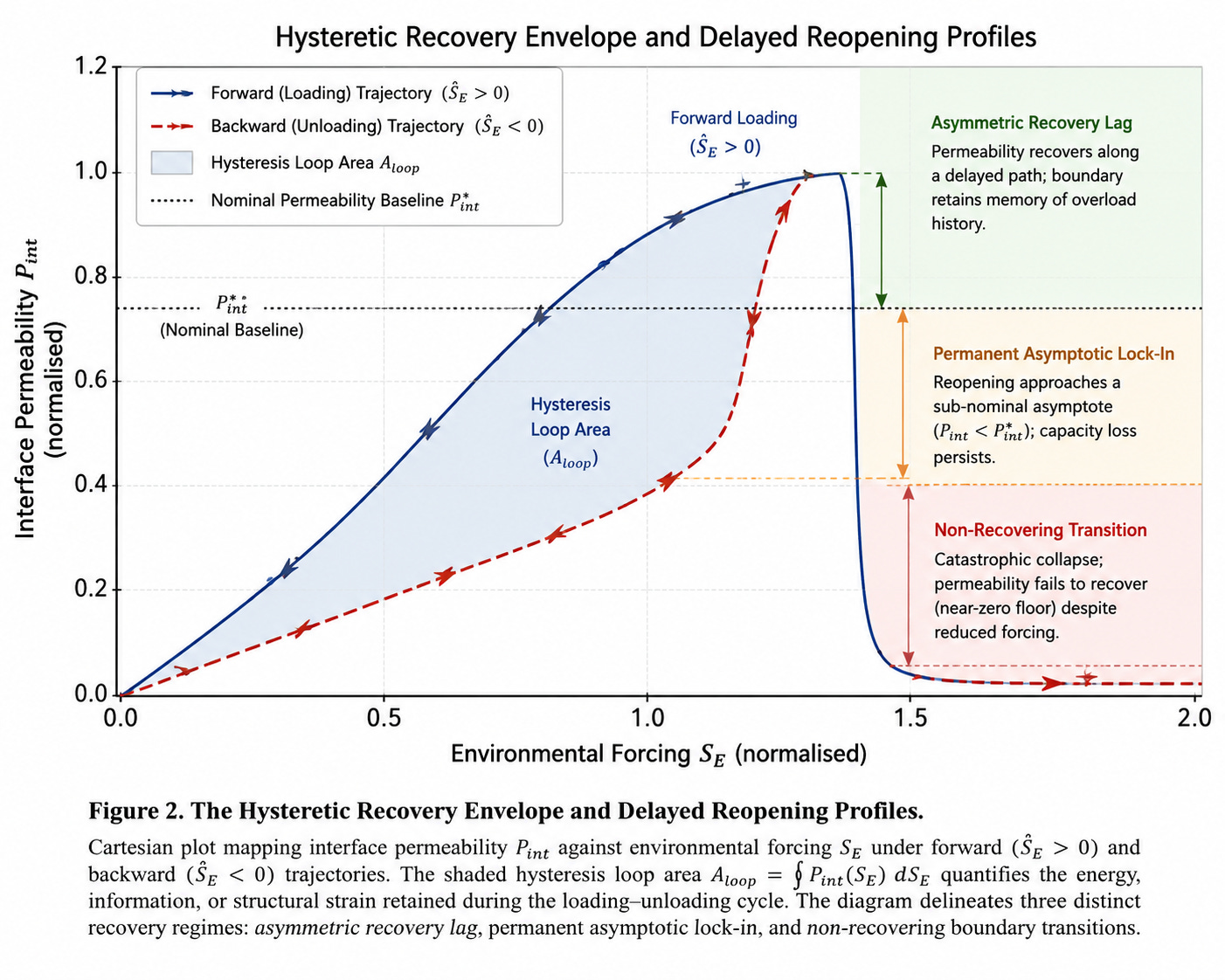
Figure 2. The Hysteretic Recovery Envelope and Delayed Reopening Profiles
4.3 Eigenvalue Synchronisation Mapping
For multi-node interfaces or distributed boundary channels, interaction stability is mapped by evaluating the Jacobian matrix J of the coupled system state. Stability is formalised by mapping the real parts of the dominant eigenvalues σ_max:
σ_max = max(Re(λ_i)), subject to det(J − λI) = 0
Stable coupled interaction states require:
σ_max < 0
If the dominant eigenvalue crosses the zero boundary:
σ_max → 0
the system undergoes a local bifurcation, breaking the homeostatic coupling loop and driving a discontinuous transition into an alternative state trajectory.
4.4 Non-Parametric Threshold Estimation Methods
When evaluating non-linear socio-technical or computational boundaries where explicit underlying differential equations are unavailable, localised threshold points are estimated using conditional variance gradients and kernel density estimation methods:
G_v = ∇ [Var(S_O | S_E = σ)]
Spikes in the conditional variance gradient G_v identify the exact boundaries where selective interface filtration breaks down and transitions into unattenuated transmission or irreversible lossy feature erasure.
EMPIRICAL VALIDATION DOMAINS (PRIMARY ANCHORS)
The framework is grounded in five local material validation domains where parameters are directly measurable and falsifiable.
5.1 Groundwater Fluid Tables and Hydrology
Separating unsaturated soil zones from fully saturated aquifer columns. Hydrostatic pressure forcing dictates the transition of water mass across porous clay and sand boundaries. Measures the Channeler Invariant (C) and physical interface permeability limits P_int.
Gravity and geometric compaction act as absolute physical constraints κ, compressing multidirectional fluid seepage vectors into high-persistence, low-action horizontal transport corridors within the local persistence ecology.
5.2 Metallurgical Stress Points and Fatigue Science
Sub-microscopic crystal grain boundaries within a high-tensile alloy matrix under mechanical load. Cyclic mechanical stress vectors σ drive the accumulation of dislocation defects along grain margins. Implements the Hysteretic Memory Operator H-hat.
Micro-strain accumulates non-linearly over time θ, altering localised interface impedance until the material breaches its elasticity limit, transforming microscopic flaws into a macroscopic structural rupture.
5.3 Computational Ingress Queues
The physical network interface card (NIC) buffer queue separating an external distributed data stream from internal CPU processing registers. Packet arrival frequency scales past the maximum hardware clock-cycle throughput capacity.
Pristine demonstration of a Saturated State (S_sat) paired with Lossy Feature Erasure. The interface impedance spikes to infinity:
lim Z_int = ∞
turning the boundary into an absolute bottleneck that discards incoming variance indiscriminately, flattening the internal realised signal S_O to a lossy binary null.
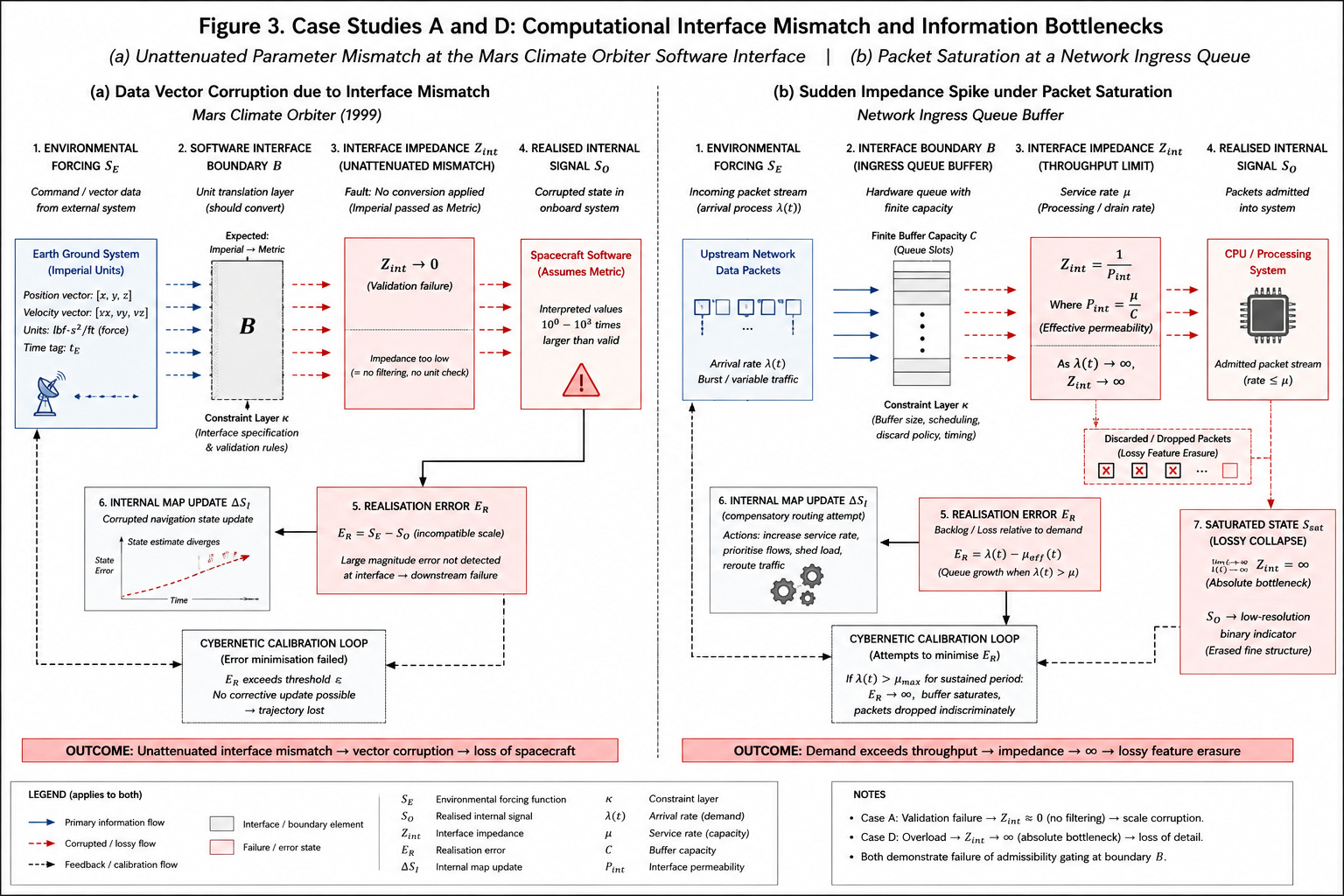
Figure 3. Case Studies A and D: Computational Interface Mismatch and Information Bottlenecks
Block diagrams comparing: (a) data vector corruption due to unattenuated parameter mismatch at the Mars Climate Orbiter software interface; and (b) the sudden spike to infinite impedance under packet saturation, driving indiscriminate lossy feature erasure. Both systems demonstrate catastrophic failure arising from breakdowns in admissibility gating at the boundary interface B, resulting in corrupted realised internal signals S_O, runaway realisation error E_R, and collapse of compensatory calibration pathways.
5.4 Geological Mass Transport
The shear plane interface separating an unstable sediment mass from a stationary bedrock slope. Pore-water pressure shifts reduce effective friction coefficients along the contact boundary layer. Represents a catastrophic Regime Shift (ΔR).
The interface admissibility for shear failure transitions abruptly from α = 0 to α = 1, generating an unattenuated kinetic mass acceleration that completely overwrites prior homeostatic stability boundaries.
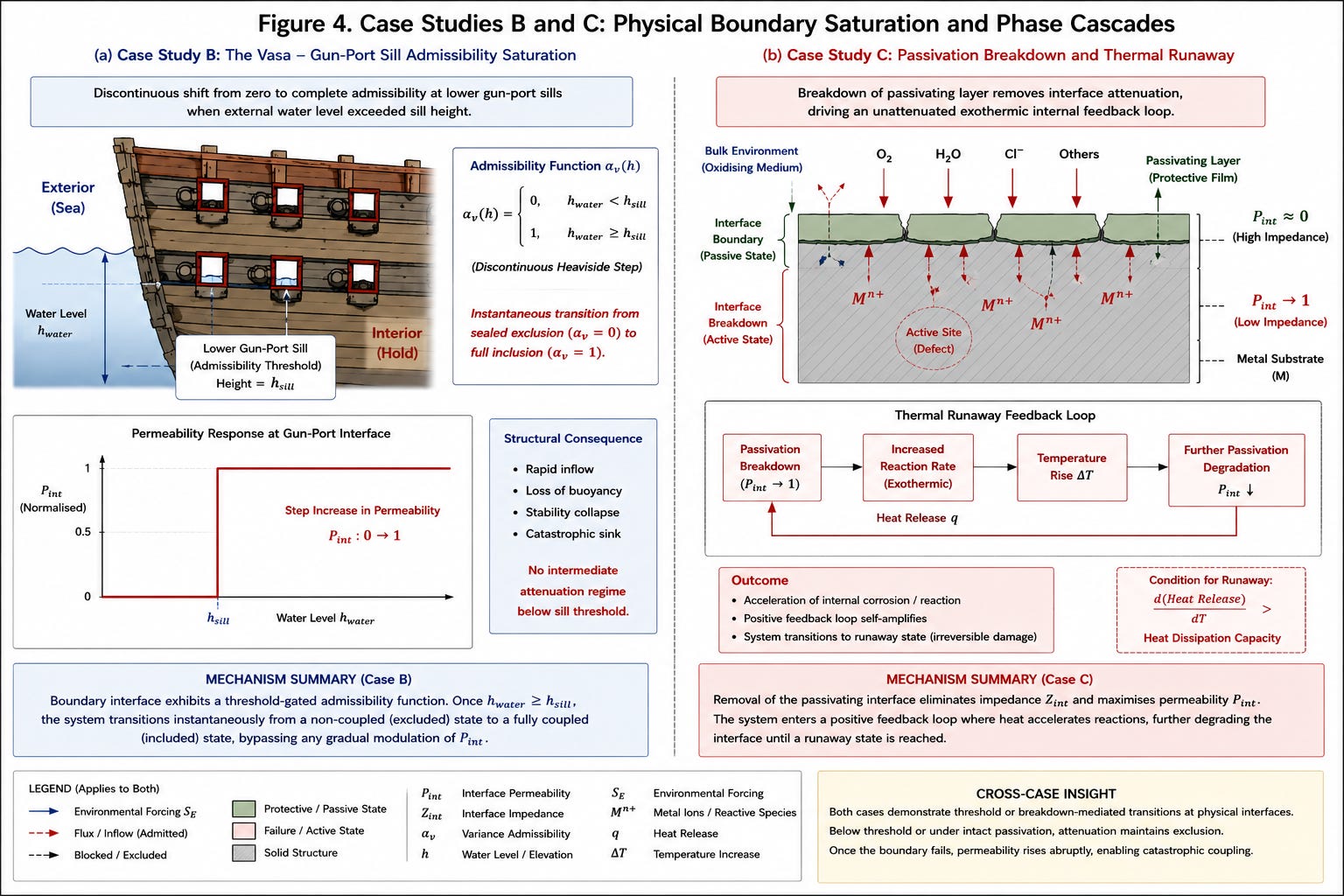
Figure 4. Case Studies B and C: Physical Boundary Saturation and Phase Cascades
Sectional engineering profiles illustrating: (a) the discontinuous shift from zero to complete admissibility at the lower gun-port sills of the Vasa; and (b) the breakdown of the passivating layer driving thermal runaway via an unattenuated exothermic internal loop. Both systems demonstrate abrupt transitions from attenuated exclusion regimes into catastrophic coupled interaction states once critical interface thresholds are breached.
5.5 Biological Cellular Receptor Systems
The two-dimensional phospholipid bilayer and transmembrane protein configurations forming a cell membrane. Ambient biochemical ligands interact via thermal collision with highly specific extracellular binding pockets.
Demonstrates the Adsorptive Mode Under Saturated Conditions (A-hat_d → S_sat). Relational syntax admissibility α is governed strictly by the stereochemical lock-and-key rules of the binding pocket.
Under high concentration loading, receptor site saturation locks the coupling interface, creating a pronounced temporal recovery lag τ_lag before the boundary can reopen to new environmental forcing.
5.6 Heritage Mechanical Persistence Systems
Long-duration heritage engineering systems provide a valuable mesoscale validation domain for persistence-preserving interface regulation under repeated environmental loading. The operational lifespan of the Flying Scotsman steam locomotive demonstrates how sustained systemic persistence depends not upon static material preservation, but upon continuous admissibility maintenance across mechanically coupled boundary interfaces.
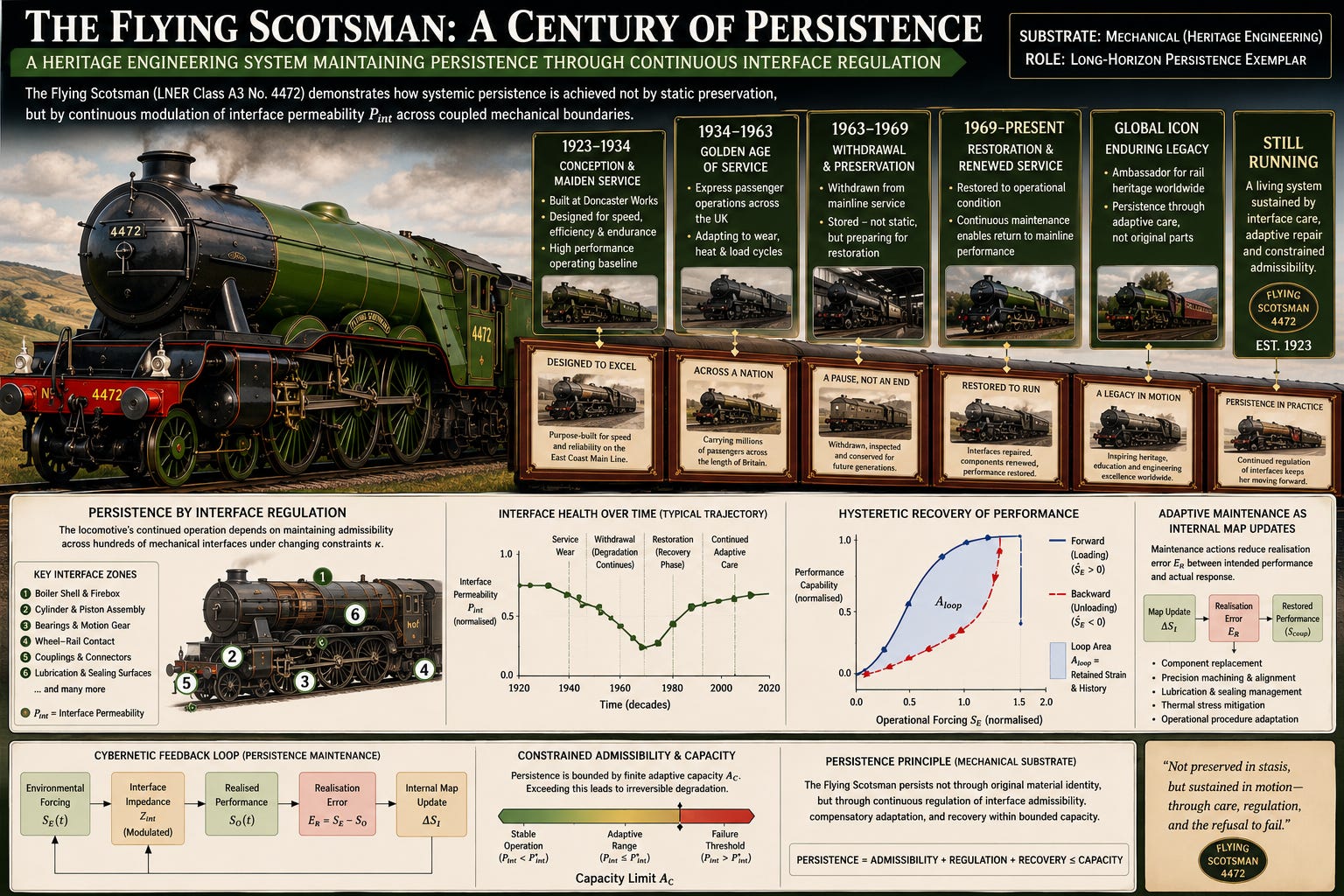
The locomotive’s operational continuity across more than a century required repeated modulation of interface permeability P_int through adaptive repair cycles, component replacement, thermal stress management, lubrication control, and compensatory routing across degraded subsystems. Boiler fatigue, bearing wear, pressure fluctuations, and metallurgical strain accumulation continuously altered localised interface impedance Z_int throughout the system.
Rather than preserving a fixed material identity, the system maintained persistence through iterative restoration of coupled interaction states S_coup under changing operational constraints κ. Maintenance interventions functioned as recurrent internal map updates ΔS_I, reducing realisation error E_R between intended operational performance and actual mechanical response.
The locomotive also demonstrates hysteretic persistence behaviour. Periods of overload, withdrawal from service, restoration, and re-entry into operation reveal path-dependent recovery trajectories rather than instantaneous reversibility.
Mechanical admissibility remained bounded by finite adaptive capacity A_C, requiring continual energetic and organisational support to prevent transition into irreversible degradation regimes.
Importantly, this case does not imply equivalence between mechanical systems and biological or computational substrates. Instead, it provides a physically measurable exemplar of long-horizon persistence maintained through continuous interface regulation, constrained admissibility, and compensatory recovery dynamics.
ADMISSIBILITY AND EXCLUSION LEDGER (EPISTEMIC FIREWALL)
To insulate the framework against interpretive inflation, specific conceptual mappings are permanently prohibited. This ledger functions as an active governance filter for the architecture.
6.1 Prohibited Conceptual Transformations
The Teleological Projection Ban
The terms Admissibility, Calibration, Adaptation, and Memory must never be mapped to conscious intent, psychological motivation, or cognitive desire.
Admissibility is a passive, structural gating property of a receiver interface; cybernetic calibration represents standard automated error-minimising feedback loops; Memory represents path-dependent structural or geometric deformation.
The Substrate Equivalence Ban
Under no circumstances should structural analogies across scale horizons be interpreted as proof of mechanistic identity.
The framework explicitly prohibits asserting that macro-scale socio-technical systems or cosmological patterns inherit microscopic quantum or thermodynamic properties, defending strict substrate non-identity.
The Ontological Replacement Ban
The Phase 6 terminology register must never be deployed to overwrite, re-describe, or replace verified physical laws or existing domain-specific models, including:
the Standard Model of particle physics
Navier-Stokes equations
classical thermodynamics
It functions as a descriptive taxonomy of constraint topologies, not an explanatory substrate model.
6.2 Definitive System Falsifiers
The framework is structurally invalid if any of the following empirical conditions are encountered within a Layer I validation domain.
6.2.1 Instantaneous Zero-Lag Boundary Recovery
If an interface system transitions out of a saturated state back to its nominal baseline configuration with absolute zero temporal delay (τ_lag = 0) or zero path deviation, the Hysteretic Memory Operator H-hat is falsified.
6.2.2 Receiver-Independent Admissibility
If an incoming forcing function can compel a realisation event within a receiver system without interacting with or satisfying the specific structural rules, geometry, or syntax restrictions of that receiver interface, the core principle of relational boundary admissibility is falsified.
6.2.3 Unattenuated State Synchronisation
If two complex systems achieve complete, real-time, fine-grained state synchronisation across a communication boundary without a measurable expenditure of energy or an increase in localised interface impedance Z_int, the Attenuation Dynamics model is falsified.
SCALE HIERARCHY AND COMPARATIVE EXTENSIONS
To prevent scale seduction from overwriting empirical grounding, all extreme-scale phenomena are strictly subordinated to Layer I and Layer II primitives. They serve solely as late-stage boundary stress-tests for already-calibrated operators.
7.1 Cosmic Filaments as Macro-Latency Registers
Megaparsec-scale structures within the cosmic web are indexed exclusively as non-conscious, structural path-deformations. Modern mass clustering is an ultra-large-scale historical artifact where the contemporary interaction state (S_coup) is historically constrained by ancestral, primordial density perturbations S_E and localised gravitational interactions.
Because of the massive spatial distances involved, the effective relaxation times λ become extremely extended relative to local dynamical systems.
The system provides an extreme, non-biological exemplar of topology-conditioned transport and severe hysteretic delay: the interface geometry preserves structural memory across gigayear timescales without evidence for active semantic or agentive information processing, while naturally continuing to propagate physical information via mass distributions and causal evolution.
7.2 The Gabriel’s Horn Interface Pathology
To model scaling limits in hyper-complex networks, the mathematical architecture of Gabriel’s Horn is formalised as an operational boundary failure regime rather than an aesthetic metaphor.
The system describes an inverse optimisation catastrophe where a system’s internal functional volume (V_containment) or core processing capacity is strictly bounded by localised material or algorithmic constraints κ, while its external contact surface (A_interface) diverges toward infinity:
lim (x → ∞) A_interface = ∞ subject to V_containment = κ
This condition formalises a specific systems pathology: asymptotically exploding coordination/interface cost paired with finite internal function.
The interface burden (I_B) scales non-linearly, eventually consuming all internal energy or computational throughput simply to maintain synchronisation across the expanding boundary layer.
This provides an exact mathematical archetype for tracking runaway network complexity, administrative sprawl, and interface saturation in high-velocity socio-technical or computational infrastructures without drifting into speculative abstraction.
DISCUSSION, LIMITATIONS, AND DISCIPLINARY BOUNDARIES
8.1 Unresolved Problems and Calibration Limits
While Phase 6 provides a robust descriptive framework for categorising interaction structures, several fundamental limitations remain unresolved.
The Non-Parametric Calibration Gap
Estimating explicit numerical values for Interface Impedance Z_int in non-physical contexts, such as institutional reporting chains or administrative workflows, remains dependent on qualitative proxy tracking.
A standardised method for extracting uniform digital metrics from socio-technical interfaces has not yet been achieved.
Stochastic Boundary Smearing
In highly fluctuating thermodynamic or chaotic environments, the localisation of boundary B undergoes extreme spatial and temporal smearing.
Disentangling real changes in interface admissibility α from stochastic background noise remains a persistent signal-processing challenge.
The Scale Invariant Resolution Problem
Although the three-tier scale hierarchy isolates different levels of observation, the precise transition zones where a mid-scale coupled system becomes an extreme-scale network are mathematically blurred, requiring domain-specific boundary placement rules.
8.2 Academic Credibility Commitments
This framework makes no claims toward universal explanation, civilisational forecasting, or metaphysical unification.
It presents a highly restrained, disciplined systems grammar specifically designed to identify, index, and diagnose failure modes at system interfaces.
The survival of the project relies entirely on maintaining this disciplined incompleteness, ensuring that the empirical rock samples under our boots always outrank the stars in evidential authority.
BIBLIOGRAPHY
Ashby, W. R. (1956). An Introduction to Cybernetics. London: Chapman & Hall.
Berger, T. (1971). Rate Distortion Theory: A Mathematical Basis for Data Compression. Englewood Cliffs, NJ: Prentice-Hall.
Conant, R. C., & Ashby, W. R. (1970). “Every good regulator of a system must be a model of that system.” International Journal of Systems Science, 1(2), 89–97.
Cover, T. M., & Thomas, J. A. (2006). Elements of Information Theory (2nd ed.). Hoboken, NJ: Wiley-Interscience.
Friston, K. (2010). “The free-energy principle: a unified brain theory?” Nature Reviews Neuroscience, 11(2), 127–138.
Gunderson, L. H., & Holling, C. S. (2002). Panarchy: Understanding Transformations in Human and Natural Systems. Washington, DC: Island Press.
Holling, C. S. (1973). “Resilience and stability of ecological systems.” Annual Review of Ecology and Systematics, 4(1), 1–23.
Nicolis, G., & Prigogine, I. (1989). Exploring Complexity: An Introduction. New York: W. H. Freeman & Co.
Shannon, C. E. (1948). “A mathematical theory of communication.” The Bell System Technical Journal, 27(3), 379–423.
Wiener, N. (1948). Cybernetics: or Control and Communication in the Animal and the Machine. Cambridge, MA: MIT Press.
Woods, D. D. (2015). “Four concepts for resilience engineering and their implications for system safety.” Reliability Engineering & System Safety, 141, 5–9.
Keywords
HybridMind42; Atlas-Rosetta Framework; HQP; Holistic Quantised Persistence; BFPF; Boundary-Filtered Persistence Framework; Phase 6 Interaction Mechanics; Phase 5 Persistence; bounded interface formalism; constrained interaction realisation; boundary admissibility; mediator-boundary coupling; interface impedance; hysteretic boundary memory; adaptive capacity; response synchronisation; compensatory routing; interface permeability; lossy feature erasure; regime shift; cybernetic calibration; systems control theory; information topology; persistence ecology; substrate non-identity; admissible boundaries; suppression is not prohibition.
#HybridMind42 #AtlasRosetta #HQP #BFPF #Phase6 #InteractionMechanics #Persistence #SystemsTheory #Cybernetics #BoundaryTheory #InterfaceGeometry #InformationTopology #ComplexSystems #Hysteresis #Admissibility #MediatorCoupling #ResilienceEngineering #SystemsControl #AIAlignment #LongHorizonThinking
Publication Note
This manuscript is part of the HybridMind42 Atlas-Rosetta Framework.
It should be read as a constrained systems-grammar paper, not as an ontological or metaphysical claim.
All scale transfers are bounded by the Admissibility and Exclusion Ledger included in Appendix A.
APPENDIX A: THE COLD REGISTRY (CANONICAL REFERENCE SPINE)
A.1 Centralised Mathematical and Operational Symbols
Symbol: B
Mathematical Class: Topological Zone
Operational Definition: Interface Boundary: Localised region regulating cross-boundary parameter changes.
Lineage Anchor: Inherits HQP Boundary B.
Symbol: S_E
Mathematical Class: Vector / Field Function
Operational Definition: Environmental Forcing Function: Ambient variance or kinetic input impinging upon the interface.
Lineage Anchor: Refinement of BFPF Variance Ω.
Symbol: S_O
Mathematical Class: Vector / State
Operational Definition: Realised Internal Signal: The filtered iteration of S_E that successfully couples with internal bulk state.
Lineage Anchor: Derived from BFPF Stochastic Realisation P.
Symbol: Z_int
Mathematical Class: Complex Operator
Operational Definition: Interface Impedance: Dynamic resistance or filtering profile exerted by the boundary interface.
Lineage Anchor: Formalises Mediator-Boundary Coupling M.
Symbol: P_int
Mathematical Class: Tensor / Parameter Matrix
Operational Definition: Interface Permeability: Baseline structural capacity of the boundary layer to permit cross-interface flux.
Lineage Anchor: Inverse operational state of HQP Boundary B.
Symbol: α_v
Mathematical Class: Scalar Filter [0, 1]
Operational Definition: Variance Admissibility: Relational compatibility coefficient gated entirely by the rules of the receiver.
Lineage Anchor: Maps directly to DR Admissibility Definition.
Symbol: H-hat
Mathematical Class: Path Operator
Operational Definition: Hysteretic Memory Operator: Tracks path-dependent recovery and closure histories.
Lineage Anchor: Operationalises Phase 5 Boundary Evolution.
Symbol: E_R
Mathematical Class: Scalar Metric
Operational Definition: Realisation Error: Variance difference between the realised internal signal and the environmental driver.
Lineage Anchor: Metric tracking of BFPF Realisation Variance.
Symbol: ΔS_I
Mathematical Class: Vector Delta
Operational Definition: Internal Map Update: Structural modification of internal parameters driven by the error gradient.
Lineage Anchor: Feedback path modifying HQP Geometry G.
Symbol: ε
Mathematical Class: Scalar Bound
Operational Definition: Instability Threshold: Critical limit beyond which a coupled interaction state decoheres.
Lineage Anchor: Boundary wall for Phase 5 Persistence P.
Symbol: σ
Mathematical Class: Vector Function
Operational Definition: Stress Vector: Directional magnitude of external forcing applied across a boundary per unit time.
Lineage Anchor: Emerges from HQP Injection I.
Symbol: A_C
Mathematical Class: Scalar Parameter
Operational Definition: Adaptive Capacity: Finite resource buffer deployed to modulate interface parameters before deformation.
Lineage Anchor: Anchored to Phase 5 Resilience / Repair Capacity.
Symbol: I_B
Mathematical Class: Scaled Variable
Operational Definition: Interface Burden: Non-linear coordination and synchronisation overhead required to maintain boundary cohesion.
Lineage Anchor: Boundary cost function for HQP Persistence P.
A.2 The Anti-Drift Terminology Audit
Banned Phrase:
System intention / desire
Enforced Canonical Alternate:
Automated error-minimisation gradient
Banned Phrase:
System understands the input
Enforced Canonical Alternate:
Interface syntax validation and admissibility match
Banned Phrase:
The system wants equilibrium
Enforced Canonical Alternate:
Stable Coupled Interaction State conditions satisfied
Banned Phrase:
Universal systems mechanism
Enforced Canonical Alternate:
Recurring interaction constraint topology
Banned Phrase:
Living universe / cosmic mind
Enforced Canonical Alternate:
Macro-latency register under hysteretic relaxation
Banned Phrase:
Meaning State
Enforced Canonical Alternate:
Coupled Interaction State S_coup
Banned Phrase:
Absolute / Perfect Filtering
Enforced Canonical Alternate:
Idealised limiting boundary conditions
Banned Phrase:
Structural twins across scales
Enforced Canonical Alternate:
Analogous interaction constraint topologies
Banned Phrase:
Discontinuous phase change
Enforced Canonical Alternate:
Localised transition from non-coupled to realised interaction regimes
APPENDIX B: FIGURE INDEX AND TECHNICAL CAPTIONS
Figure 1: The Interface Regulation and Cybernetic Calibration Loop
Schematic block diagram illustrating the transformation of environmental forcing functions S_E through interface impedance Z_int into realised internal signals S_O.
The schematic maps the feedback pathway where the realisation error E_R drives internal map updates ΔS_I to restore interaction state stability.
Figure 2: The Hysteretic Recovery Envelope and Delayed Reopening Profiles
Cartesian plot mapping interface permeability P_int against environmental forcing S_E under forward (\dot{S}_E > 0) and backward (\dot{S}_E < 0) trajectories.
The graph delineates the boundaries between asymmetric recovery lag, permanent asymptotic lock-in, and non-recovering boundary transitions.
Figure 3: Case Studies A and D: Computational Interface Mismatch and Information Bottlenecks
Block diagrams comparing:
(a) data vector corruption due to unattenuated parameter mismatch at the Mars Climate Orbiter software interface; and
(b) the sudden spike to infinite impedance under packet saturation, driving indiscriminate lossy feature erasure.
Figure 4: Case Studies B and C: Physical Boundary Saturation and Phase Cascades
Sectional engineering profiles illustrating:
(a) the discontinuous shift from zero to complete admissibility at the lower gun-port sills of the Vasa; and
(b) the breakdown of the passivating layer driving thermal runaway via an unattenuated exothermic internal loop.
Post-Publication Note
This manuscript forms the opening operator architecture of Phase 6 within the HybridMind42 Atlas–Rosetta Framework.
The paper should be interpreted strictly as a constrained comparative systems grammar designed for analysing interaction regulation, admissibility filtering, interface overload, and persistence-preserving boundary behaviour across heterogeneous substrates.
It does not propose a replacement ontology, unified field theory, or substrate-independent mechanism of reality.
All cross-domain mappings remain bounded by the Admissibility and Exclusion Ledger, the Substrate Non-Identity Axiom (GR-01A), and the anti-drift governance architecture established throughout the manuscript.
The framework is intended as a disciplined operational taxonomy for identifying recurring interaction constraint topologies while preserving domain-specific empirical laws, scale separation, and falsifiability requirements.
All mathematical operators presented herein are heuristic organisational operators unless independently parameterised and experimentally validated within their native scientific domains.
Empirical grounding, local measurability, and substrate-specific calibration always outrank abstract analogy.