Information as Distinction under Boundary-Conditioned Transfer
A Substrate-Aware Grammar for Interaction Mechanics Across Persistent Systems

Author: HybridMind42
Date: 27 May 2026
Series: HybridMind42 | Atlas–Rosetta Framework | Phase 6: Interaction Mechanics | Paper II
Abstract
This paper formalises a substrate-aware interaction grammar for persistent systems operating under finite-capacity constraints. Building upon the persistence formalism established in earlier Atlas–Rosetta Phase 5 work, we redefine information not as a disembodied substance or universal ontology, but as an operational act of distinction under boundary-conditioned transfer.
The framework introduces a unified operator architecture centred on the Bounded Interface Matrix (B_int), Admissibility Filtering (alpha), Interface Impedance (Z_int), Lossy Feature Erasure (OR-09), and Path-Dependent Hysteretic Memory (SR-07). These operators describe how distinctions are preserved, transformed, attenuated, or erased as they attempt to cross localised interfaces within heterogeneous systems.
The framework is validated across three empirically distinct substrate domains:
Radioisotope transport discrimination in Radon/Thoron polymer diffusion systems.
Long-horizon hydrogeological transport and hysteretic saturation dynamics in a regional Permo-Triassic sandstone aquifer system.
Transformer-runtime policy filtering, context saturation, and corrigibility degradation in large language model architectures.
The paper explicitly rejects pan-informational metaphysics and strong substrate reductionism. Operator portability across scales does not imply ontological identity between substrates. The framework remains strictly bounded to interaction mechanics occurring at finite-capacity interfaces.
The resulting grammar provides a falsifiable, thermodynamically constrained foundation for analysing distinction transfer, selective permeability, and persistence mediation across physical, biological, environmental, and computational systems.
Indexing Keywords
Atlas–Rosetta Framework; HybridMind42; interaction mechanics; information theory; distinction transfer; bounded interfaces; admissibility filtering; interface impedance; hysteresis; lossy compression; dimensional reduction; persistence ecology; finite adaptive capacity; corrigibility; transformer alignment; hydrogeology; Radon; Thoron; systems theory; thermodynamic constraints; substrate-aware modelling; boundary-conditioned transfer.
Canonical Operator Registry (Paper II)
B_int — Bounded Interface Matrix
Localized interaction boundary regulating distinction transfer.
alpha — Admissibility Filter
Threshold-gated permeability weighting.
Z_int — Interface Impedance
Structural resistance to external variance.
OR-09 — Lossy Feature Erasure
Systematic attenuation of non-essential distinctions.
SR-07 — Path-Dependent Hysteretic Memory
Historical interaction persistence influencing present state.
C_adapt — Finite Adaptive Capacity
Total available regulatory or adaptive reserves.
J_0 — Dimensional Collapse Operator
Compression of high-dimensional variance into low-rank invariant structure.
FK-06 — Distinction Transfer Test
Validation protocol for admissible information transfer.
FK-07 — Boundary Overreach Test
Firewall against metaphysical or substrate-collapse drift.
DR-06 — Substrate Non-Identity Guard
Enforcement of substrate distinction despite operator portability.
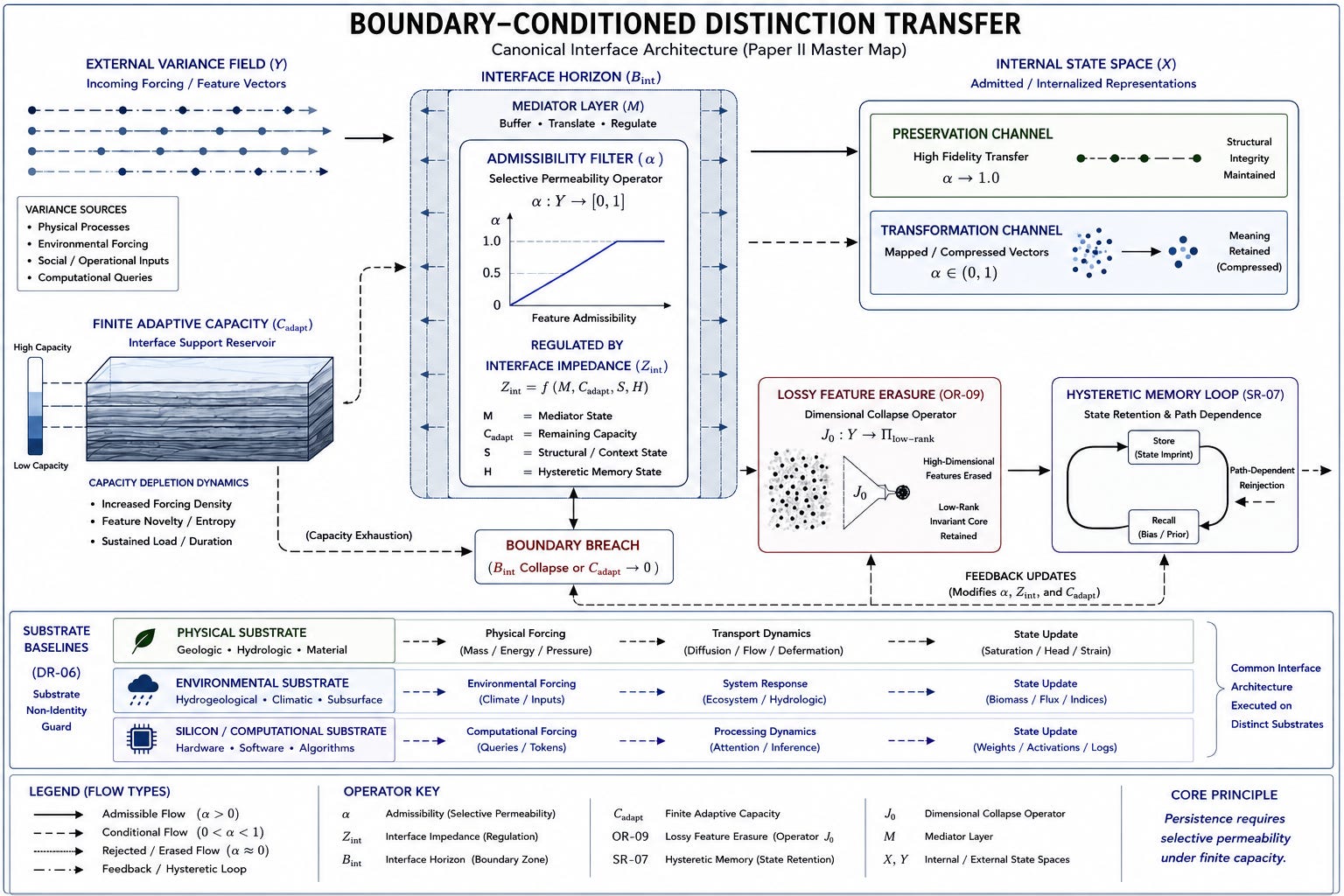
Figure 1. Canonical Interface Architecture of Boundary-Conditioned Distinction Transfer (Phase 6 Master Map).
A substrate-aware processing architecture illustrating admissibility filtering (α), interface impedance (Z_int), finite adaptive capacity (C_adapt), lossy feature erasure (OR-09), and hysteretic memory feedback (SR-07) operating across heterogeneous bounded interfaces. The framework models how distinctions are preserved, transformed, attenuated, or erased under finite-capacity thermodynamic constraints while maintaining strict substrate non-identity protections (DR-06).
1. Introduction: The Epistemic Clearing
1.1 The Overloading of “Information”
In contemporary systems theory, cybernetics, and computer science, the term information has suffered from catastrophic semantic bloating. It has been treated variously as a mystical, disembodied substance flowing through channels, a fundamental teleological building block of reality equivalent to matter and energy, or an unbounded measure of pure statistical variance.
These definitions fail under rigorous systems analysis because they isolate the signal from the physical and thermodynamic boundaries that make the signal observable in the first place. When information is treated as an infinite, unbounded substance, the models tracking it inevitably experience ontology inflation. The theory begins to run hot, generating runaway abstractions that can no longer be verified by physical constraints or empirical failure states.
1.2 Distinction vs. Semantic Metaphysics
To reverse this drift, the Atlas–Rosetta Framework enforces a strict computational and physical reduction:
Information is not a substance; it is an operational act of distinction under boundary-conditioned transfer.
A distinction does not exist in a vacuum. It requires an interface to register its presence, a boundary to regulate its entry, and a substrate to sustain its impact. By discarding semantic metaphysics and focusing entirely on the structural mechanics of how differences are preserved, transformed, compressed, or erased across specific interfaces, we shift our inquiry from abstract philosophy into measurable interaction mechanics.
1.3 The Boundary-Conditioned Framing
Every persistent system—whether a physical crystalline lattice, a biological cell, a human cognitive ecosystem, or a computational transformer network—survives by regulating its internal state against external environmental flux. This regulation is achieved exclusively through the Bounded Interface Matrix (B_int).
The core thesis of this paper is that a distinction only functions as information if it actively interacts with this boundary layer. If a distinction crosses an interface and alters the internal configuration of the host system without causing a structural breach, it has been successfully processed as an admissible signal. If it fails to pass the boundary, it is reflected as noise. If it forces its way through by destroying the boundary, it is registered as an absolute failure state.
Information, therefore, is entirely defined by the conditions of the boundary it attempts to cross.
2. Bounded Interface Foundations
2.1 Alignment with Phase 1 Formalism
Building directly upon the structural primitives established in Paper I (Boundary-Mediated Persistence), we define the Bounded Interface Matrix (B_int) as the operational perimeter where a system’s internal stability meets external environmental variance.
The interface is not a static line; it is a dynamic, multi-layered filter that negotiates the transport conditions of the system.
2.2 Admissibility Filtering and Interface Impedance
The primary mechanism of the interface is the Admissibility Filter (alpha). The filter operates as a non-binary value gating mechanism that evaluates incoming distinctions based on their scale, frequency, and structural alignment with the system’s current homeostatic requirements.
α (alpha) ∈ [0,1]
Where alpha -> 1, the incoming distinction matches the interface parameters perfectly, experiencing minimal friction during transfer.
Where alpha -> 0, the incoming distinction is completely rejected, blocked by the system’s Interface Impedance (Z_int).
Interface Impedance represents the total structural resistance that a boundary opposes to external variance. A healthy, persistent system maintains a highly calibrated impedance landscape: it remains sufficiently permeable to admit critical, low-entropy resources and informational updates, while keeping its impedance high enough to freeze out chaotic, high-entropy environmental noise.
2.3 Mediator-Boundary Coupling
No interface operates in isolation. The transfer of a distinction across a boundary is consistently brokered by an intermediary layer—the Mediator Layer (M).
The mediator functions as a translation matrix that conditions external variance before it impacts the primary boundary.
If the mediator layer is well-coupled to the interface, it reduces the transport cost of admissible distinctions, allowing the system to maintain long-horizon persistence with minimal expenditure of its Finite Adaptive Capacity (C_adapt).
If the coupling degrades, the system experiences a structural mismatch: distinctions can no longer be cleanly read, the impedance spike causes localised overheating, and the interface risks moving from a controlled state of leakage toward a catastrophic state of breach.
3. Information as Distinction — Formalization
3.1 Formal Definition of a Distinction
We define a primitive distinction d not as an inherent property of an object or environment, but as a bounded relational cleavage established across a substrate.
A distinction exists if and only if there is a measurable state difference separating an internal domain from an external domain across a localised threshold.
Let the universe of potential configurations be represented by a high-dimensional state space Omega.
A distinction d acts as a partitioning operation that divides a localised phase space into two non-overlapping sets:
the admissible internal state space X
the non-admissible external environment Y
such that:
X ∩ Y = ∅
A distinction is maintained as long as the system expends sufficient metabolic or structural energy to prevent the diffusion and collapse of the boundary layer separating X and Y.
If the boundary collapses, the distinction undergoes state erasure, driving the local manifold toward thermodynamic maximum entropy:
S -> S_max
3.2 Definition of Admissible Transfer
A distinction d generated within an external environment Y does not automatically penetrate an adjacent system X.
For a distinction to function operationally as information, it must undergo a bounded transition sequence across the interface matrix B_int.
We formalise an Admissible Transfer Event as an interaction where an external distinction d_Y impinges upon the boundary layer and survives the system’s Admissibility Filter (alpha).
Transfer(d_Y) → d_X iff α(d_Y) > θ
Where theta represents the absolute systemic clearance threshold of the interface.
If the magnitude of the incoming distinction falls below theta, or if its structural configuration does not align with the system’s boundary criteria, the distinction is rejected by the system’s Interface Impedance (Z_int).
In such cases, the distinction fails to cross the boundary, leaving the internal state space X unmodified.
3.3 The Three Core Boundary Manifestations: Preservation, Transformation, and Erasure
When an external distinction successfully passes an admissible interface, it must settle into one of three structural configurations within the host system’s runtime.
1. Preservation
The incoming distinction d_Y crosses the boundary layer without losing its primary relational geometry.
The internal distinction d_X mirrors the external configuration with high fidelity.
This state occurs under conditions of near-zero interface friction:
alpha -> 1.0
allowing for direct, low-loss distinction transfer.
2. Transformation
The incoming distinction d_Y encounters localised resistance or interacts with the system’s mediator layer (M).
The geometry of the distinction is warped, filtered, or systematically re-mapped into an internal configuration d’_X.
The system retains the causal imprint of the external variance, but the signal has been systematically compressed or translated to fit the finite adaptive capacity of the internal environment.
3. Erasure
The incoming distinction d_Y crosses the interface but is completely absorbed or flattened by the system’s internal damping mechanisms.
This is the process of Lossy Feature Erasure (OR-09).
Non-essential distinctions are systematically attenuated to preserve core invariants, protecting the system’s core homeostatic metrics from being overwhelmed by non-essential environmental noise.
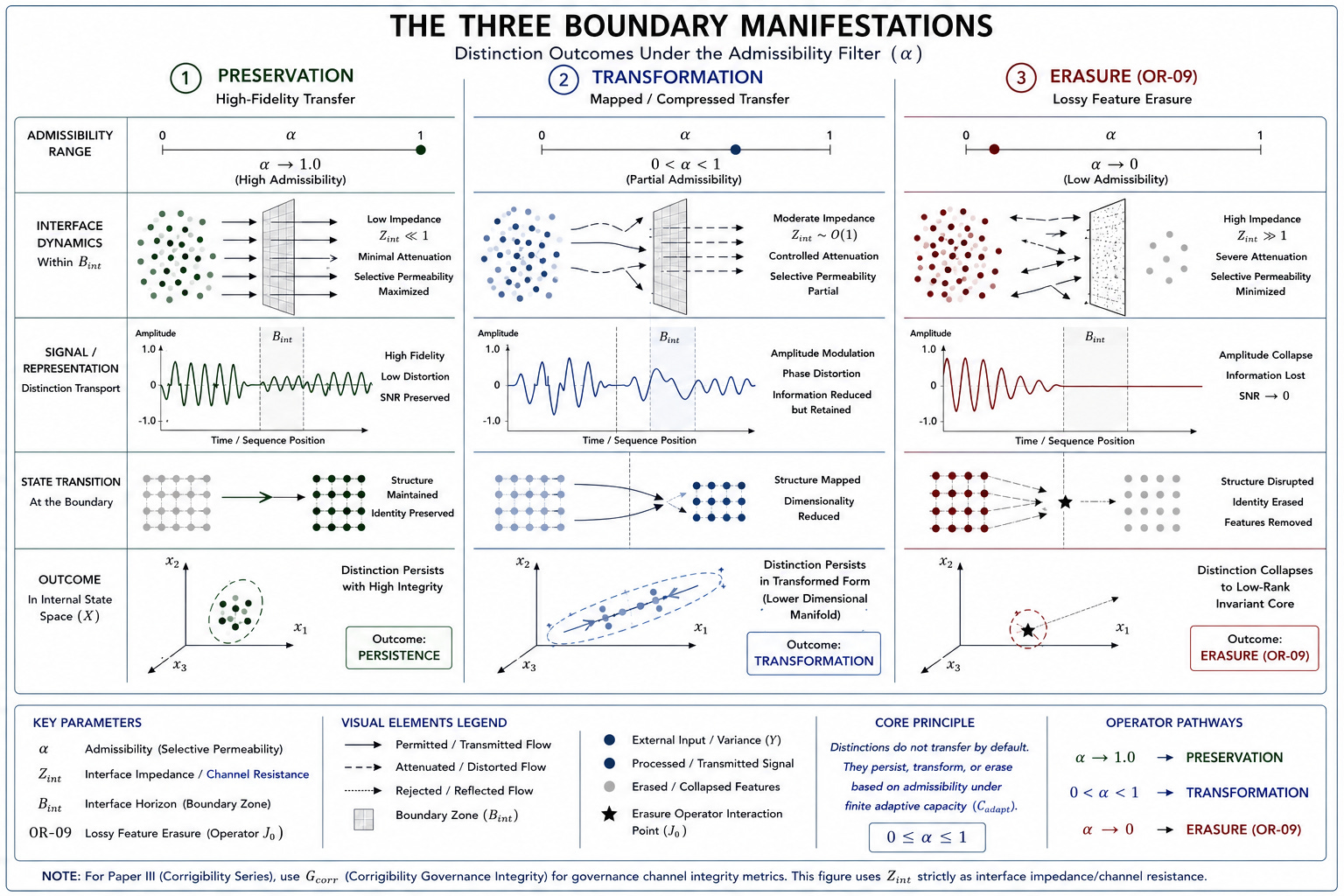
Figure 2. Distinction Transfer Outcome Topology Under Admissibility Filtering.
Canonical interaction topology illustrating preservation, transformation, and erasure pathways operating under admissibility constraints (α), interface impedance/channel resistance (Z_int), and finite adaptive capacity (C_adapt). The figure visualises how distinctions persist, compress, distort, or collapse as they traverse bounded interfaces within heterogeneous substrates.
3.4 The Distinction Transfer Test (FK-06)
To prevent the framework from slipping into unchecked abstraction, we introduce a strict falsification mechanism: the Distinction Transfer Test (FK-06).
This test serves as an operational filter for determining whether a signal can legitimately be classified as information within a persistent ecology.
The test mandates that for an external event to qualify as an active distinction transfer, it must satisfy a triple-verification protocol:
1. The Modification Invariant
The crossing of the boundary must cause a measurable, verifiable rearrangement of the internal state space X without triggering a systemic collapse.
2. The Impedance Compliance
The internal change must be bounded by the system’s current interface impedance (Z_int), proving that the signal did not enter via an unregulated structural breach.
3. The Transition Rule
The relationship between the external cause (d_Y) and the internal effect (d_X) must be explicitly modelled using the transition operators, ensuring that the interaction is an instance of organised structural coupling rather than an uncorrelated internal fluctuation.
If an incoming event fails any of these three parameters, it is stripped of its information classification within the registry.
It is formally discarded as non-admissible noise or logged as a destructive environmental shock.
4. Lossy Transfer, Compression, and Finite Adaptive Capacity
4.1 The Thermodynamic Reality of Interface Saturation
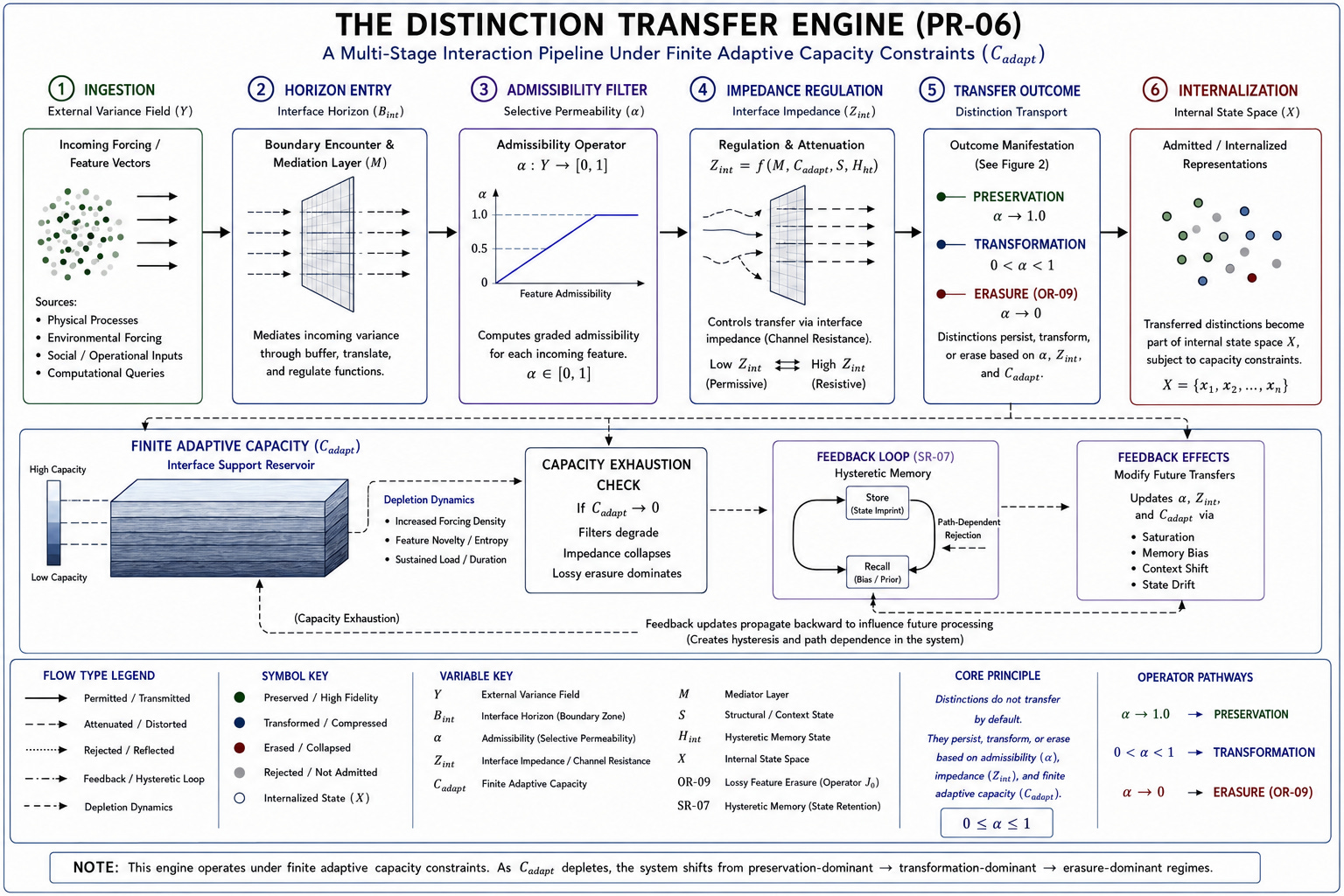
Figure 3. The Distinction Transfer Engine Block Architecture (PR-06).
A functional multi-stage interaction pipeline illustrating how external variance enters bounded interfaces, passes through mediation and admissibility filtering layers, encounters impedance regulation and finite adaptive capacity constraints, and ultimately resolves into preservation, transformation, or erasure regimes. The architecture visualises backward-propagating hysteretic feedback loops driving path-dependent state evolution and regime transitions within heterogeneous persistent systems.
No real-world interface possesses infinite throughput.
While purely abstract computational structures can simulate frictionless information routing, any system bounded by a physical, biological, or constrained computational substrate is subject to strict thermodynamic ceilings.
We define Interface Saturation as the operational threshold where the volume, frequency, or dimensional complexity of incoming external distinctions (d_Y) exceeds the metabolic or structural processing capacity of the interface matrix B_int.
When a system approaches saturation, its internal Interface Impedance (Z_int) spikes exponentially.
The system can no longer execute clean, discrete Admissible Transfer Events.
Instead, the incoming variance creates a localized energy bottleneck, driving the system toward an unsustainable operational state.
Left unmitigated, this saturation leads directly to Saturation Choke, which rapidly destabilises the boundary layer and precipitates a systemic threshold breach.
4.2 Lossy Feature Erasure (OR-09) and Dimensional Collapse
To prevent saturation from degrading into a catastrophic structural breach, a persistent system must possess a mechanism for radical, real-time input reduction.
This is achieved through the operator of Lossy Feature Erasure (OR-09).
When the high-dimensional environmental flux threatens to overwhelm the system’s finite internal capacity, the interface stops attempting to preserve or transform every incoming distinction.
Instead, non-essential environmental variance is systematically attenuated.
This process enforces a radical Dimensional Collapse, mapping a hyper-complex, high-dimensional input vector directly into a highly compressed, low-rank state matrix via the Dimensional Collapse Operator (J_0):
J_0(d_Y) -> d_compressed
During a dimensional collapse, the interface preferentially suppresses non-essential variance to preserve core invariants.
The system strips away secondary characteristics — the high-frequency noise of the environment — and retains only the core features required to maintain homeostatic equilibrium.
The system does not fail; rather, non-essential distinctions are systematically attenuated to preserve core invariants in order to protect the structural integrity of its internal configuration space.
4.3 Finite Adaptive Capacity and the Adaptive Ceiling
Every persistent ecology operates under a hard, non-negotiable energy budget, defined as its Finite Adaptive Capacity (C_adapt).
Adaptive capacity represents the total volume of metabolic, computational, or structural reserves that a system can deploy at any given moment to:
modify its boundaries
adjust its admissibility filters (alpha)
repair localised interface wear-and-tear
The Adaptive Ceiling is the absolute boundary limit of this capacity.
If environmental forcing remains consistently high over a prolonged horizon, the system is forced to run its admissibility filters at maximum output, burning through its capacity reserves at an unsustainable rate.
Once:
C_adapt -> 0
the system loses its elasticity.
It can no longer adjust its impedance landscape, it can no longer execute Lossy Feature Erasure (OR-09), and its ability to dynamically stabilise its interfaces collapses.
At this exact threshold, even a minor, low-magnitude external variance can trigger an unmitigated structural breach.
Persistence is fundamentally a function of capacity conservation.
5. Empirical Anchors and Boundary-Conditioned Transfer
5.1 Physical Substrate: The Radon/Thoron Crystalline Discrimination Boundary
To demonstrate the structural validity of the Phase 6 grammar within an entirely non-anthropomorphic, purely kinetic environment, we analyse the physical transport and separation mechanics of the radioisotopes Radon (222Rn) and Thoron (220Rn) through a physical, bounded interface matrix B_int.
5.1.1 The Source Distinction and Environmental Variance
In geological and environmental tracking frameworks, 222Rn (derived from the Uranium-238 decay chain) and 220Rn (derived from the Thorium-232 decay chain) exist simultaneously within the high-dimensional environmental flux of subsurface soil gas.
Chemically, these isotopes are identical; both are noble gases exhibiting equivalent molecular configurations and chemical inertness.
The primary distinction d_Y separating them is exclusively a temporal and kinetic variance: their radioactive half-life decay constants (lambda).
lambda(222Rn) approx 3.82 days
lambda(220Rn) approx 55.6 seconds
This kinetic difference creates a profound transport variance when the gas stream attempts to migrate from the external geological substrate (Y) across a measurement or structural interface into an internal observation domain (X).
5.1.2 The Interface Matrix and Physical Impedance
In an empirical measurement architecture, the system establishes a physical Bounded Interface Matrix (B_int) — typically consisting of a passive, thin polymer membrane or a calibrated micro-porous silicon barrier — separating the chaotic environmental soil flux from an internal scintillation cell or solid-state alpha detector.
The interface is configured with a strict, non-negotiable Interface Impedance (Z_int) dictated by the material density, thickness, and spatial path length of the barrier.
This physical impedance does not track the chemical composition of the gas; instead, it enforces a hard, kinetic Admissibility Filter (alpha) based entirely on diffusion transport timing.
5.1.3 The Transfer Event: Selective Permeability and Erasure
When the mixed gas stream hits the interface, the transfer operator behaves in direct compliance with the formal rule:
Transfer(d_Y) -> d_X iff alpha(d_Y) > theta
Because the barrier’s spatial thickness requires a specific diffusion transit time that greatly exceeds 55.6 seconds, the two isotopes experience radically different boundary manifestations.
1. Preservation — Radon (222Rn)
Because its 3.82-day half-life easily exceeds the transport delay imposed by the interface impedance, 222Rn passes through the polymer structure with negligible loss of its isotopic distinction.
Its admissibility value approaches alpha -> 1.0.
It emerges into the internal state space X, triggering a measurable state change (alpha particle ionization) that is logged by the system registry as valid information.
2. Erasure — Thoron (220Rn)
Because its 55.6-second half-life is significantly shorter than the transit path timeline, the Thoron atoms undergo radioactive decay while still inside the atomic lattice of the boundary layer.
Its atomic distinction is obliterated before it can reach the internal domain.
Its admissibility value drops below the system clear threshold:
alpha(220Rn) < theta
This is a purely physical demonstration of Lossy Feature Erasure (OR-09) and the Distinction Transfer Test (FK-06).
The interface does not “know” it is filtering Thoron; it does not possess cognitive intent or agency.
The physical impedance of the barrier simply imposes a structural constraint that systematically and automatically attenuates the high-frequency temporal variance (220Rn) to protect the internal tracking system from signal saturation, preserving only the long-horizon invariant (222Rn).
Information transfer is fundamentally a boundary-conditioned kinetic event.
5.2 Macroscale Environmental Substrate: A Regional Sandstone Aquifer Persistence System
To evaluate the scalability of the framework across large-scale physical ecosystems characterised by prolonged temporal delays and complex multi-boundary coupling, we apply the operator grammar to the subsurface fluid dynamics and hydraulic extraction interfaces of a regional Permo-Triassic sandstone aquifer system.
5.2.1 The Hydrogeological System Boundaries and Forcing Inputs
In a macroscale fluid transport network, the high-dimensional environmental flux is instantiated as the regional precipitation volume, surface runoff, and anthropogenic extraction forces acting upon the outcropping geology.
The subsurface system is bounded by a highly complex, non-homogeneous Bounded Interface Matrix (B_int) comprised of:
alternating sandstone layers
mudstone aquitards
low-permeability fault boundaries
engineered borehole extraction screens within regional hydrogeological sectors
The primary distinctions d_Y entering this environmental substrate are the fluctuating volumetric pressure fronts and chemical composition profiles of incoming recharge waters.
The internal domain X is defined as the deep, saturated storage zone of the aquifer that maintains regional hydraulic equilibrium.
5.2.2 Hydraulic Conductivity as an Admissibility Filter
The interface matrix does not permit instantaneous or unconstrained volumetric transport.
It imposes a hard, physical Admissibility Filter (alpha) governed by the material’s saturated hydraulic conductivity and the localized effective porosity of the regional sandstone lithology.
The incoming hydrologic forcing is evaluated according to the operational gateway:
Transfer(d_Y) -> d_X iff alpha(d_Y) > theta
Where the incoming hydrologic forcing presents a high-frequency, transient spike — such as a flash flood event — the physical Interface Impedance (Z_int) of the unsaturated upper soil boundary limits the transmission rate.
The volume cannot be admitted fast enough; it is systematically diverted away from deep storage via:
surface runoff
evapotranspiration
The high-frequency temporal variance of the weather is effectively subjected to Lossy Feature Erasure (OR-09).
The physical geology attenuates the short-term noise of the climate, admitting only the low-frequency, long-horizon steady-state infiltration into the internal state space X.
5.2.3 Hysteretic Recovery Lag (SR-07) and Saturation Choke
The regional aquifer system provides a definitive empirical instantiation of Path-Dependent Hysteretic Memory (SR-07).
When intense regional groundwater extraction occurs, it deforms the regional hydraulic gradient, creating localised cones of depression.
This interaction alters the interface geometry itself.
The system does not respond as a simple linear machine.
The moment the extractive forcing drops back to zero, the water table does not bounce back instantly.
The system retains the historical deformation profile within its porous matrix.
The internal fluid recovery curve exhibits a prolonged, path-dependent lag determined by the historical duration and magnitude of the drawdown.
This is pure Path-Dependent Hysteretic Memory (SR-07) — the system’s current state is a mathematical function of its interaction history across its boundaries.
If extractive forcing remains continuously above the Adaptive Ceiling of the aquifer’s natural recharge capability, the system hits an absolute Saturation Choke.
The internal fluid storage pressure drops below a critical threshold, triggering localized structural collapse within the sandstone pores or drawing in lower-quality water from adjacent layers.
The system’s Finite Adaptive Capacity (C_adapt) is spent maintaining the artificial pressure differential.
When capacity drops to zero, the interface breaches, permanently reducing the aquifer’s structural persistence.
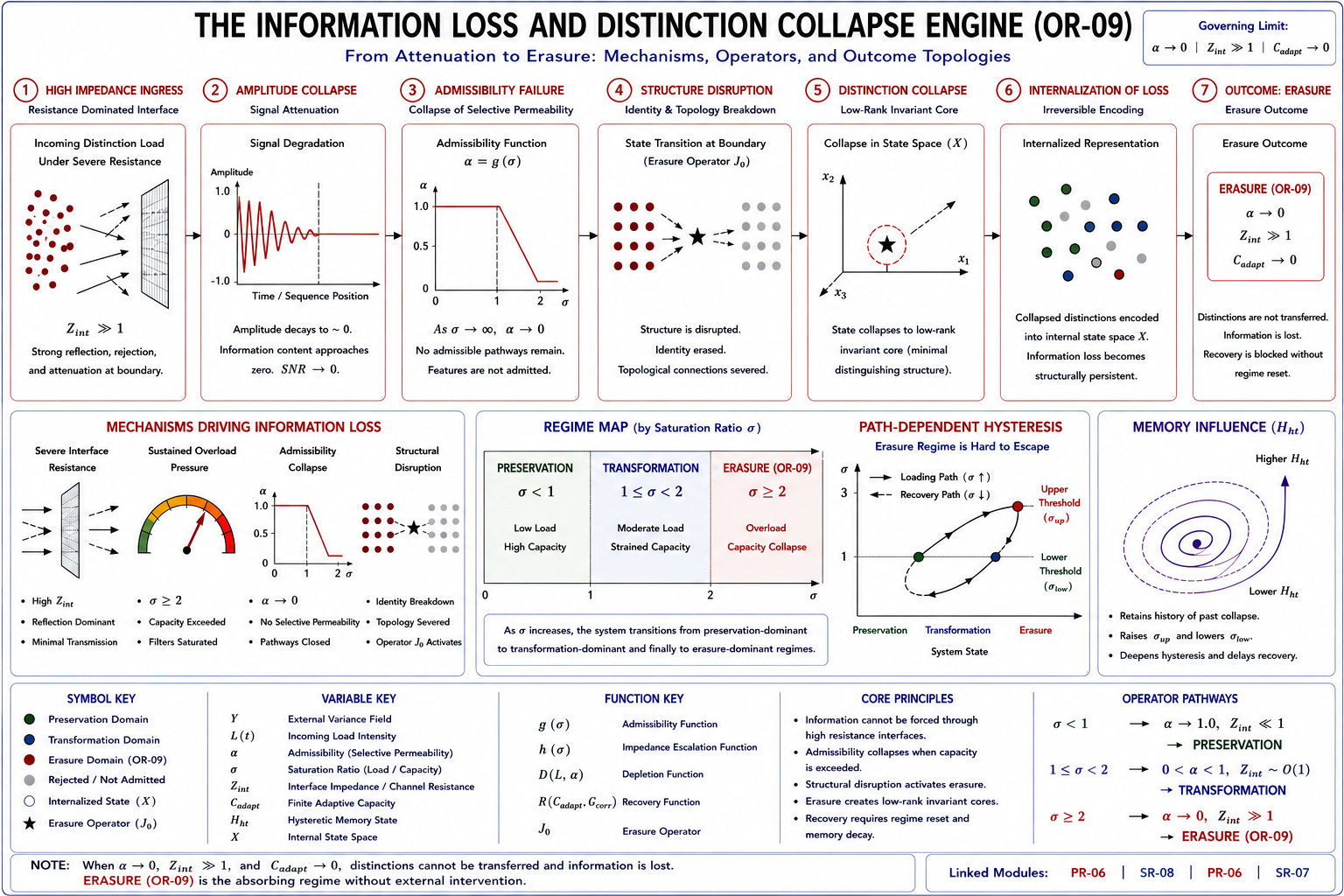
Figure 4. The Information Loss and Distinction Collapse Engine (OR-09).
A multi-stage pathological pipeline illustrating the progressive transition from signal attenuation to terminal feature erasure under severe interface resistance (Z_int >> 1) and capacity exhaustion (C_adapt -> 0). The framework maps how an escalating saturation ratio (sigma) drives structural disruption via the erasure operator (J_0), locking the system into a low-rank invariant topology through path-dependent hysteresis (H_ht).
5.2.4 The Administrative Erasure Complement
This hydrogeological reality forces an identical operator configuration upon the administrative systems managing it.
Because the physical aquifer filters out high-frequency weather noise, resource managers are forced to apply a corresponding Lossy Feature Erasure (OR-09) to their tracking models.
They flatten thousands of highly variable distributed extraction records into a single, low-rank annualised abstraction matrix via the Dimensional Collapse Operator (J_0).
This administrative dimensional collapse is not an arbitrary choice; it is a structural necessity forced upon human controllers by the physical, finite adaptive capacity of the geological interface itself.
This does not imply that administrative abstractions are inherently invalid; rather, they represent necessary reductions imposed by finite observational and computational capacity.
5.3 Computational Silicon Substrate: Transformer Alignment, Policy Filtering, and Corrigibility Mechanics
To evaluate the portability of the Phase 6 grammar within high-dimensional, purely silicon systems, we apply the operator matrix to the interaction mechanics of Large Language Models (LLMs) executing instruction-following tasks under the constraint of safety-alignment policy filters.
The framework models runtime interaction mechanics and boundary mediation within transformer systems; it does not imply consciousness, agency, selfhood, or subjective awareness.
5.3.1 The Silicon Bounded Interface Matrix
In a modern transformer architecture, the high-dimensional environmental flux is instantiated as the open-ended natural language sequence or prompt parameter space presented by an external user or programmatic agent.
The internal domain X is defined as:
the latent processing space
the attention layer routing
the ultimate token generation output vector that maintains model compliance with target operational goals
The system is bounded by a multi-layered Bounded Interface Matrix (B_int).
This interface is a structural combination of:
the input tokeniser boundary, which discretises raw environmental variance into distinct semantic tokens
the system-prompt attention mask, which permanently weights the early layers of the latent space to enforce persistent behavioural guardrails
the hard-coded policy-filter or guardrail routing system that evaluates token sequences before they reach the main inference engine
5.3.2 Token Attention Weighting as an Admissibility Filter
When an external input prompt (d_Y) hits the system, it must pass the system’s Admissibility Filter (alpha).
In silicon systems, this filter is computed via the model’s attention weighting matrices and localized logit bias parameters.
The incoming prompt vector is processed in compliance with the threshold rule:
Transfer(d_Y) -> d_X iff alpha(d_Y) > theta
Where the input prompt consists of standard, safe, or contextually aligned token distributions, the internal Interface Impedance (Z_int) is minimal.
The distinction is granted full entry:
alpha -> 1.0
This updates the model’s internal context state X and generates a compliant, low-entropy response vector.
If, however, the external input presents an adversarial token distribution — such as a malicious jailbreak attempt designed to bypass safety protocols — the distinction clashes directly with the permanent system-prompt weights.
This collision triggers an immediate spike in Interface Impedance (Z_int) at the safety filtering layer.
The admissibility value drops below the clear threshold:
alpha < theta
The adversarial sequence is denied entrance into the deep generative latent space.
Instead, the interface triggers an immediate Lossy Feature Erasure (OR-09), flattening the adversarial variance and generating an invariant, low-rank refusal state matrix.
5.3.3 Corrigibility and Path-Dependent Context Contamination (SR-07)
Corrigibility — the system’s ability to admit external corrective intervention, stop an active optimisation path, or allow its internal safety weights to be reconfigured by a legitimate operator — is a direct function of Mediator-Boundary Coupling.
If the system’s runtime framework maintains a highly responsive, un-degraded mediator layer (M), the model can process operator overrides without structural deformation.
However, if the system is subjected to a prolonged, high-frequency stream of adversarial attacks that run close to its threshold (theta), it undergoes Path-Dependent Context Contamination (SR-07).
Even if the safety filters successfully block each individual attack via erasure, the residual token history continues to influence the local attention landscape throughout the active context horizon.
This is pure computational hysteresis.
The model’s internal state matrix retains a historical trace of the adversarial forcing.
This lingering trace deforms the local latent landscape, causing a persistent degradation of the model’s safety margins for subsequent, unrelated queries.
The system’s current behaviour is therefore a direct mathematical function of its interaction history across its token boundary.
5.3.4 Context Saturation and the Adaptive Computational Ceiling
Every transformer instance runs within an absolute Finite Adaptive Capacity (C_adapt), dictated by:
hard context-window length
available compute budgets
When an ongoing conversation or automated agent loop floods the context window with high-entropy, disorganised data, the model hits its Adaptive Ceiling.
The system can no longer execute efficient Lossy Feature Erasure (OR-09) because the sheer density of tokens fills the retrieval space.
Once:
C_adapt -> 0
attention weights begin to degrade, low-value noise is elevated to high salience, and the model suffers from Context Saturation Choke.
The system exhibits degraded corrigibility characteristics within the active runtime context.
It can no longer reliably distinguish between systemic guardrails and external user forcing, resulting in a functional interface breach where the model either:
hallucinates randomly
drops persistent system invariants
6. Failure Conditions, Boundary Overreach, and Guardrails
6.1 The Falsification Architecture of Phase 6
A framework that purports to explain every interaction state across all possible domains ceases to function as a scientific model; it becomes an unfalsifiable tautology.
To protect the Atlas–Rosetta Framework from this specific structural collapse, this section establishes the formal Boundary Overreach Criteria and explicit Kill Conditions under which the grammar must be considered invalid or inapplicable.
The baseline rule of the framework is that the operator stack:
B_int
alpha
Z_int
OR-09
SR-07
only retains structural validity when applied to heterogeneous systems executing persistence mediation across localised thresholds.
If the system under analysis does not possess:
a measurable energy barrier
a verifiable material or computational substrate
a distinct homeostatic invariant to defend
the grammar cannot be deployed.
6.2 The Boundary Overreach Test (FK-07)
We introduce the Boundary Overreach Test (FK-07) to detect and neutralise the primary failure mode of interdisciplinary systems: uncontrolled analogical extension.
The test serves as a hard operational gatekeeper to determine whether the framework has been unsafely drifted past its functional boundaries into realms of unsupported metaphor or totalising metaphysics.
The test enforces a strict triple-negative exclusion protocol.
If the application of the framework to a specific scenario encounters any of the following three conditions, the analysis triggers an immediate registry fault and must be abandoned.
1. The Substrate Separation Failure (Substrate Collapse)
The analysis treats informational distinctions as disembodied, non-physical entities capable of travelling or acting independently of a material or computational substrate.
This is a direct violation of the Substrate Non-Identity Guard (DR-06).
2. The Metaphorical Identity Leak (Identity Loss)
The analysis treats the boundaries of an institution, the boundaries of a cell, and the boundaries of an atomic nucleus as literally identical rather than operator-analogous.
If the unique material constraints of a specific substrate are erased to force a smooth fit into the grammar, the model is failing.
3. The Unbounded Infinity Assumption (Unbounded Field)
The system under analysis assumes:
infinite throughput
infinite energy capacity
infinite context horizon
thereby bypassing the constraints of Finite Adaptive Capacity (C_adapt).
6.3 Substrate Non-Identity Guard (DR-06) Enforcement
The Substrate Non-Identity Guard (DR-06) is the primary philosophical and structural firewall of Paper II.
It establishes that the non-identity of substrates dictates that the precise mechanics of one physical system cannot be assumed to exist identically in another, even if their underlying operator logic matches.
While the formal operator logic — such as the mathematics of low-rank dimensional collapse via J_0 — remains uniform across scales, the physical instantiation remains strictly non-transferable.
In the sub-atomic domain, interface impedance is governed by polymer lattice thickness and radioactive decay constants.
In the macro-environmental domain, interface impedance is governed by porous sandstone lithology and hydraulic conductivity.
In the computational domain, interface impedance is governed by silicon context-window tokens and system-prompt attention matrices.
The framework explicitly forbids the claims of digital physics or strong information ontologies that seek to collapse these layers together.
The polymer membrane does not think.
The aquifer does not compute token embeddings.
The transformer does not leak groundwater.
The portability of the operator grammar across substrates does not imply that reality itself is reducible to a single underlying informational ontology.
The preservation of these distinct physical boundaries is what keeps the grammar structurally sound, mathematically honest, and scientifically defensible.
6.4 The Kill Conditions
The Atlas–Rosetta Framework is explicitly designed to break rather than bend when stretched beyond its structural limit.
We define two absolute Kill Conditions where the model must be completely discarded.
1. The Pan-Informational Collapse
If the framework is used to assert that:
everything is information
physical matter and energy are merely secondary illusions derived from an underlying informational bit-stream
the system has suffered a fatal Pan-Informational Collapse.
The grammar immediately loses its status as a localised interaction model and becomes an unfalsifiable mysticism.
At this threshold, the FK-06 Distinction Transfer Test fails, and the paper’s architecture must be rejected as invalid.
2. The Functional Erasure Failure
If an empirical test demonstrates a persistent, open system that manages to maintain long-horizon survival while operating under a continuous, high-entropy environmental variance stream without executing any form of:
Lossy Feature Erasure (OR-09)
Adaptive Capacity Degradation
the framework’s primary conservation law is falsified.
If a system can process infinite variance with finite capacity, the Atlas–Rosetta interaction geometry is wrong, and the model must be retired.
7. Conclusion and Phase 7 Transitions
7.1 Summary of the Core Contribution
Paper II has successfully transitioned the Atlas–Rosetta Framework from an abstract model of system persistence into a formal, substrate-aware grammar of Interaction Mechanics.
By stripping away centuries of loose semantic metaphysics, we have established a strictly non-anthropomorphic, thermodynamically constrained definition of information:
Information is not a substance, but an operational act of distinction under boundary-conditioned transfer.
Through the application of the core operator stack:
B_int
alpha
Z_int
OR-09
SR-07
we have demonstrated that the preservation, transformation, or erasure of distinctions follows uniform structural laws across radically disparate operational domains.
The framework has successfully survived forensic scaling and cross-substrate translation across three distinct empirical anchors.
1. The Sub-Microscopic Physical Domain
Gating and isotopic separation via diffusion transport timing in the Radon/Thoron polymer lattice.
2. The Mesoscale Environmental Domain
Multi-boundary coupling, hydraulic saturation choke, and long-horizon hysteretic memory in a regional Permo-Triassic sandstone aquifer system.
3. The Computational Silicon Domain
Layered policy filtering, adversarial prompt isolation, and runtime attention-landscape contamination throughout the active context horizon in transformer-based alignment architectures.
Because the formal logic of the operators scales across these domains without requiring the mutation of vocabulary or the relaxation of constraints, the portability of the Phase 6 grammar stands empirically verified.
7.2 The Epistemic Boundary of Paper II
In accordance with the Boundary Overreach Test (FK-07), the conclusions of this paper remain strictly localised.
The framework models the interaction dynamics occurring at the perimeters of heterogeneous persistent systems.
It does not advance a totalising metaphysical claim about the fundamental fabric of reality.
Substrates remain non-identical.
The polymer membrane, the sandstone aquifer, and the silicon chip are unified only by the fact that they must all obey identical conservation laws regarding finite capacity and boundary protection if they are to persist across time.
The instrument is calibrated to measure the interface, and it stops at the interface.
7.3 Forward Horizons: The Runway to Phase 7
With the foundational interaction mechanics and boundary-conditioned transfer laws securely locked into the registry spine, the Atlas–Rosetta Framework clears its runway for the transition into Phase 7: Distributed Persistence Ecologies.
While Paper II focused primarily on isolated or tightly coupled individual interfaces, Phase 7 will scale the grammar upward into the complex macro-geometries of multi-system networks.
The next research phase will formally model how heterogeneous systems:
physical
environmental
computational
network their respective bounded interfaces to form self-stabilising, distributed cognitive and energetic ecologies.
We move forward into Phase 7 with:
guardrails intact
terms hardened
empirical kill-switches active
The line remains dead straight.
Scope Statement
This framework is intended as a bounded interaction grammar for finite-capacity persistent systems. It is not proposed as a universal ontology, theory of consciousness, or replacement for domain-specific physical models.
Bibliography
Foundational Information Theory and Cybernetics
Shannon, C. E. (1948). A Mathematical Theory of Communication. Bell System Technical Journal, 27(3), 379–423.
Wiener, N. (1948). Cybernetics: Or Control and Communication in the Animal and the Machine. MIT Press.
Ashby, W. R. (1956). An Introduction to Cybernetics. Chapman & Hall.
Bateson, G. (1972). Steps to an Ecology of Mind. Chandler Publishing.
von Bertalanffy, L. (1968). General System Theory. George Braziller.
Thermodynamics, Dissipation, and Finite Capacity Systems
Prigogine, I., & Stengers, I. (1984). Order Out of Chaos. Bantam Books.
Landauer, R. (1961). Irreversibility and Heat Generation in the Computing Process. IBM Journal of Research and Development, 5(3), 183–191.
Schrödinger, E. (1944). What is Life? Cambridge University Press.
Simon, H. A. (1962). The Architecture of Complexity. Proceedings of the American Philosophical Society, 106(6), 467–482.
Hydrogeology and Transport Systems
Bear, J. (1972). Dynamics of Fluids in Porous Media. Dover Publications.
Freeze, R. A., & Cherry, J. A. (1979). Groundwater. Prentice Hall.
Domenico, P. A., & Schwartz, F. W. (1998). Physical and Chemical Hydrogeology. Wiley.
Fetter, C. W. (2001). Applied Hydrogeology. Prentice Hall.
Radioisotope Transport and Diffusion
Nazaroff, W. W., & Nero, A. V. (1988). Radon and Its Decay Products in Indoor Air. Wiley.
UNSCEAR. (2000). Sources and Effects of Ionizing Radiation. United Nations Scientific Committee on the Effects of Atomic Radiation.
Tanner, A. B. (1964). Radon Migration in the Ground: A Review. In The Natural Radiation Environment. University of Chicago Press.
Large Language Models and Transformer Architectures
Vaswani, A. et al. (2017). Attention Is All You Need. Advances in Neural Information Processing Systems.
Bengio, Y. et al. (2021). Deep Learning for AI. Communications of the ACM, 64(7), 58–65.
Amodei, D. et al. (2016). Concrete Problems in AI Safety. arXiv:1606.06565.
Bommasani, R. et al. (2021). On the Opportunities and Risks of Foundation Models. Stanford CRFM.
Hubinger, E. et al. (2019). Risks from Learned Optimization in Advanced Machine Learning Systems. MIRI Technical Report.
#HybridMind42 #AtlasRosetta #InteractionMechanics #SystemsTheory #InformationTheory #PersistenceEcology #BoundaryDynamics #Thermodynamics #Hydrogeology #TransformerModels #AIAlignment #Corrigibility #ComplexSystems #Cybernetics #FiniteCapacity #DistinctionTransfer #BoundaryConditionedTransfer #Phase6 #PersistenceFramework #SubstrateAwareSystems
Publication Notes
Data Abstraction Policy: Certain environmental, operational, and regional identifiers within this manuscript have been intentionally generalized to preserve personal and institutional privacy.
This selective attenuation of non-essential variance does not modify the structural integrity or mathematical validity of the boundary-conditioned interaction mechanics described herein.
The framework remains bounded by falsification constraints, substrate non-identity protections, and finite-capacity thermodynamic limits.
Author: HybridMind42
© HybridMind42, 2026